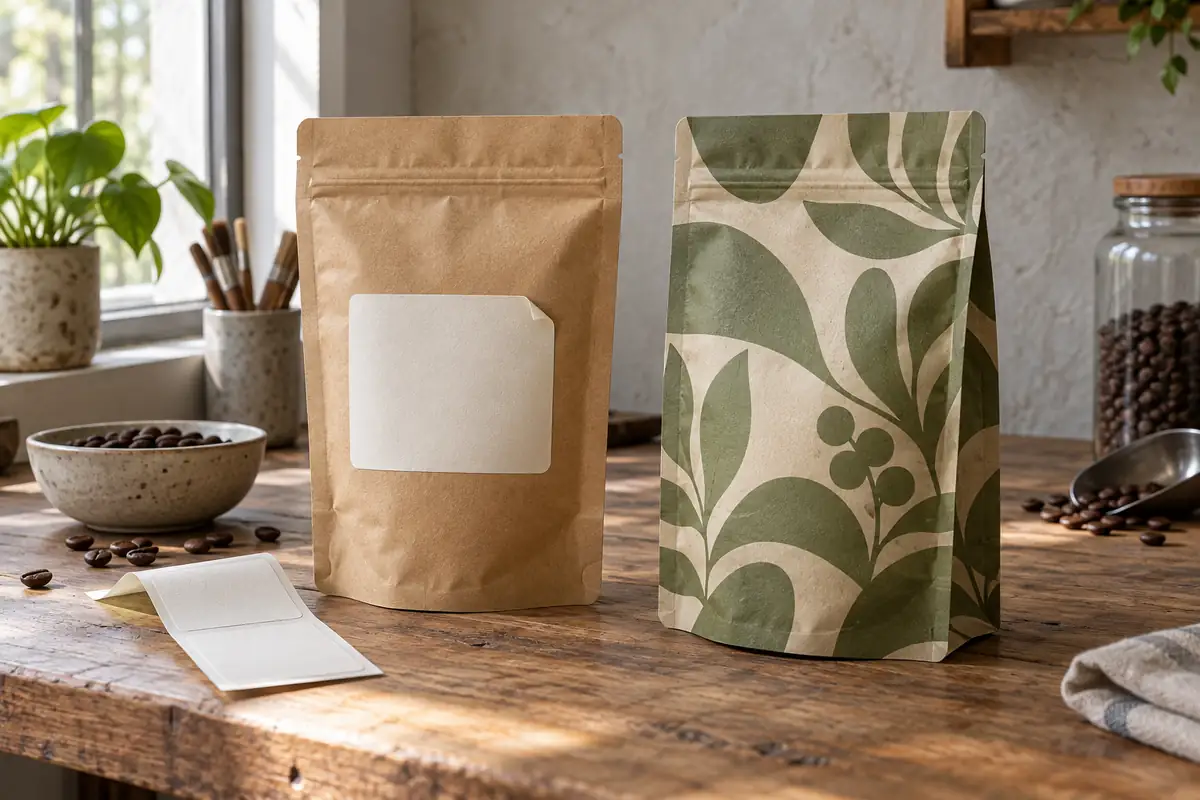
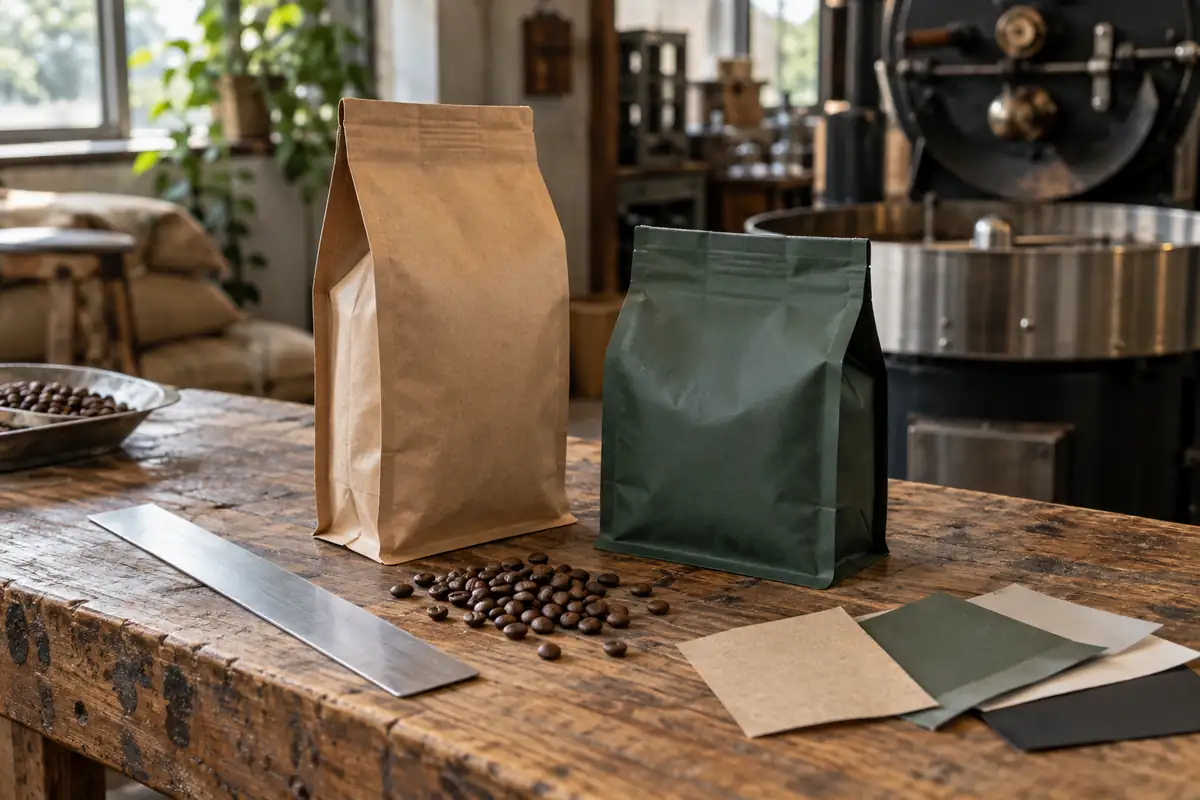
A side gusset bag has broad front and back panels, along with two printable side panels.
The front panel usually carries the main logo and product name. The back can hold brewing instructions, origin information and required labeling. The side panels provide extra room for roast level, tasting notes or secondary branding.
Artwork must account for folds and sealing areas. Small text placed too close to a gusset fold may become difficult to read after the bag is filled. The artwork template should therefore match the final bag dimensions before printing begins.
For a custom coffee packaging project, the artwork template, bag dimensions and printing areas should be confirmed together before production.
3. Can side gusset bags keep coffee fresh?
Yes, provided that the bag uses a suitable barrier structure and is properly sealed.
The bag shape does not determine freshness on its own. Protection comes mainly from the material layers, seal quality and any added features such as a degassing valve.
Roasted coffee can lose quality through exposure to oxygen, moisture and light. Depending on the product and target shelf life, the packaging may need to:
- limit oxygen entering the bag;
- control moisture transmission;
- reduce light exposure;
- retain coffee aroma; and
- withstand gas released after roasting.
A coffee sold locally within a short period may not need the same barrier level as coffee shipped internationally or stored for several months. Material selection should match the actual distribution conditions.
4. Do side gusset coffee bags need a degassing valve?
Freshly roasted whole-bean coffee packed soon after roasting generally benefits from a one-way degassing valve.
Coffee produces gases during roasting, with carbon dioxide making up a large part of them. These gases continue to leave the beans after roasting. Research has found that roast degree, storage temperature and grinding affect the rate of degassing (Wang and Lim, 2014; Smrke et al., 2018).
If freshly roasted coffee is sealed before enough gas has escaped, pressure may build inside the package. A one-way valve allows internal gas to leave while limiting air movement back through the valve.
Not every coffee package needs the same valve setup. The decision depends on:
- how soon the coffee is packed after roasting;
- whether it is whole bean or ground;
- the roast level;
- whether the coffee rests before packing;
- whether nitrogen flushing or vacuum processing is used; and
- the planned shelf life.
The Specialty Coffee Association also notes that oxygen, seal integrity, gas flushing and packaging atmosphere affect the storage life of roasted coffee. Published comparisons between individual packaging formats remain limited (Specialty Coffee Association).
The valve should be tested with the actual coffee and packing schedule. Choosing it only by bag size may not account for how quickly that coffee releases gas.
5. What coffee sizes work with side gusset bags?
Side gusset bags can be made for 250g, 500g, 1kg and larger wholesale coffee packs.
They are particularly useful for medium and large quantities because the expandable gussets provide extra internal volume while keeping the package relatively compact.
Weight alone is not enough to determine the correct bag dimensions. Two coffees with the same net weight may occupy different amounts of space because bean size, roast level and density vary. Ground coffee fills a bag differently from whole beans as well.
The final size should account for:
- the actual product volume;
- required headspace;
- top sealing allowance;
- valve position; and
- filling equipment.
Testing the coffee in physical sample bags is the most reliable way to confirm the size and finished appearance. For custom production, Illusionpack checks the product volume, required headspace, valve position and sealing allowance before the final specification is approved.
6. How do side gusset bags compare with other coffee bags?
Each coffee bag format handles capacity, shelf display and storage differently.
| Bag type | Common use | Main consideration |
|---|
| Side gusset bag | Medium and large coffee packs, wholesale quantities and compact storage | Standing stability depends on the bottom structure and fill volume |
| Flat bottom bag | Premium retail coffee and products that need a stable shelf display | The structure is more complex and may use more material |
| Stand-up pouch | Small and medium retail packs, especially when a zipper is needed | It may be less space-efficient for larger coffee quantities |
7. FAQs
1. How do I choose the right bag size?
Start with the net weight, then test the actual coffee in sample bags. Bean density, roast level, headspace, valve placement and filling equipment can all change the required dimensions.
2. Can the side panels be printed?
Yes. The front, back and side gussets can all carry printed artwork. Important text should remain clear of fold lines and sealing areas.
Explore Illusionpack’s custom side gusset bags or contact our team to discuss the size, material and valve requirements for your coffee packaging.