To order custom printed coffee bags, agree on the coffee, pouch construction and quantity before finalizing the artwork. A good-looking design cannot correct a bag that is too narrow for your filling spout or has no usable space for the top seal. This checklist helps roasters prepare one clear specification for an initial quotation and the final production approval.
For available formats and a project quotation, explore Illusionpack’s custom printed coffee bags . Use this guide to decide what information to send with your enquiry.
Prepare these six details first: whole bean or ground coffee; net fill weight; preferred bag format; material and valve requirements; quantity per artwork; and the date and destination for delivery. If a detail is undecided, mark it as a question rather than treating it as an approved specification.
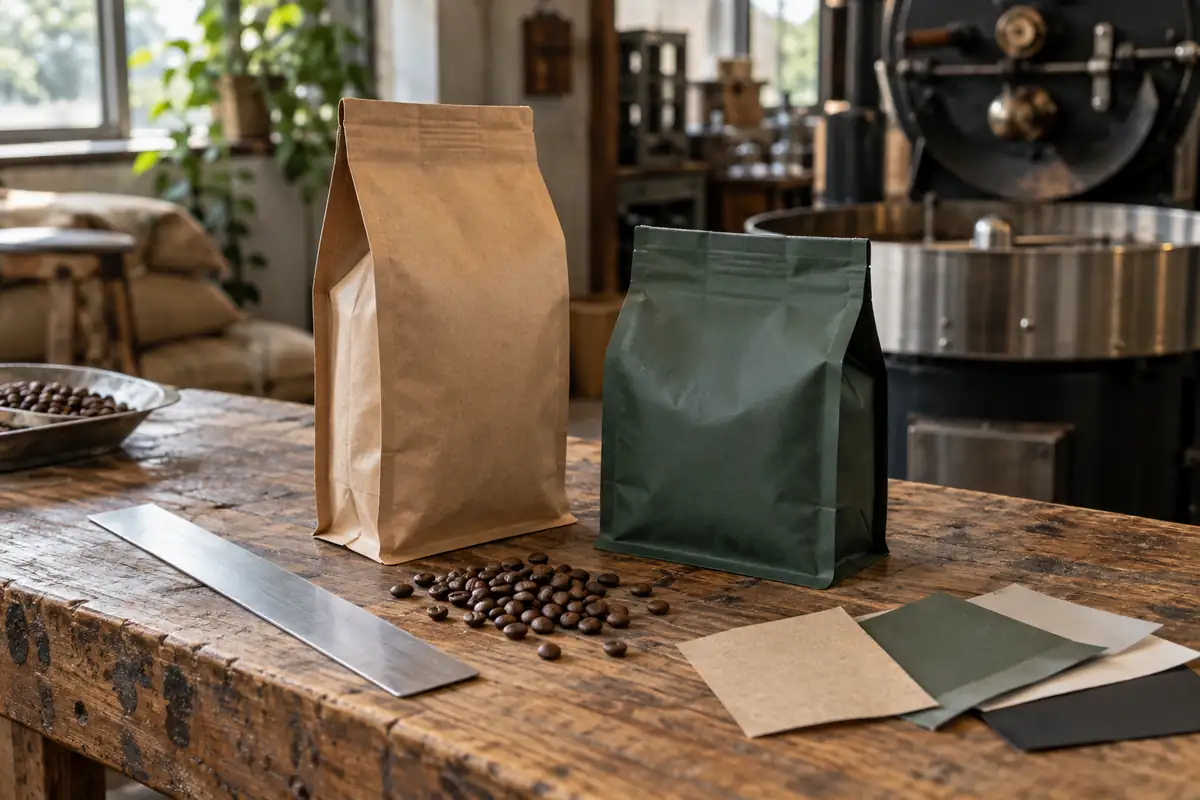
Start with how the pack will be filled, sealed, shipped and displayed. A flat-bottom bag can provide a stable base and several artwork panels. A side-gusset bag offers an expandable format that can suit compact storage or larger fills. A stand-up pouch is another option for retail packs. The useful comparison is the filled package, not the empty bag alone.
Format What to compare Question before approval Flat-bottom coffee bag Base stability, panel layout and fill access Does the opening suit your filling equipment and closure? Side-gusset coffee bag Expanded volume, storage and top closure How will the filled top be folded or resealed? Stand-up coffee pouch Bottom gusset, display and consumer access Does the pouch stand as intended at your actual fill?
Compare flat-bottom pouches , gusset pouches and stand-up pouches against the same packing requirements. Avoid changing the format simply to match a competitor’s photograph.
A flat-bottom coffee bag example. Confirm usable fill space, valve location and closure on the approved drawing. 2. Confirm Fill Capacity Instead of Copying a Bag Size A stated capacity such as 250g, 12 oz, 1 lb or 5 lb is a starting point, not a universal dimension. Whole beans and ground coffee occupy different volumes, and the space needed above the product depends on filling, sealing and closure placement. A bag sold for one coffee may not fit another coffee at the same net weight.
When requesting a wholesale quote for 12 oz coffee bags, send the intended coffee and a reference sample if available. Ask the supplier to show width, height, gusset, seal areas, zipper position and usable opening. Use the coffee bag size guide to prepare the sizing discussion, then check the proposed format with your own fill.
3. Specify the Barrier, Valve and Resealing Features Together Custom coffee packaging needs to address oxygen, moisture, light and handling as a complete construction. Ask which structure is being quoted and what performance information is available. The appearance of kraft paper or a metallic surface does not, by itself, establish the finished bag’s barrier performance.
Freshly roasted coffee releases carbon dioxide. A compatible one-way degassing valve can allow gas to escape while limiting outside air entry. Printed coffee bags with valve options should therefore be discussed alongside the roast, degassing period, filling process and target storage conditions. Ground coffee and whole beans should not automatically share an identical specification.
A zipper supports repeated opening after the initial seal. A tin tie is a different closure arrangement. Record the selected feature and its position so it does not conflict with artwork or the sealing area. Check the valve, seams and closures on a filled sample before approving the complete pack.
4. Prepare Artwork for the Actual Bag Drawing Request the current dieline for the confirmed size and format. Keep important text and barcodes away from folds, seals, zipper areas and valve locations. Identify the front, back, side panels, bottom and any areas reserved for roast dates or batch codes. A flat artwork file should show how information will read after the bag is filled.
For custom coffee bag printing, specify the substrate, finish and any white ink or special-effect areas in the artwork brief. Review small text, contrast and barcode placement at actual size. A screen proof helps check layout, but it does not demonstrate the tactile finish or filled-pouch behavior.
If your range has seasonal artwork or several origins, list every design separately. Our digital versus gravure printing guide explains questions to ask when comparing print routes. The quantity, specification and setup charges determine the relevant quotation.
5. Compare Wholesale Quotes on an Identical Specification A coffee packaging supplier can only price the information it receives. Two quotes with the same nominal capacity may use different materials, thicknesses, closures or artwork arrangements. Send one specification sheet to each supplier and ask them to identify any proposed substitution.
State the total quantity and quantity per design. Record the agreed material, dimensions, valve and closure. Separate pouch cost, applicable print setup, samples and shipping. Confirm artwork approval, production and transport as separate stages. Ask how a later artwork change or repeat order affects cost and timing. Check current lead-time guidance , then obtain dates for your actual order. A required arrival date is different from the factory completion date.
6. Approve the Pack in Stages Use available samples to assess material, opening and handling. Clarify whether the sample represents a stock construction, your printed artwork or the final production specification. Fill it with your coffee, run it through the intended sealing process and examine it after normal handling and shipping simulation.
Record the approved drawing, artwork version, construction and sample references together. Check the filled dimensions, stability, opening, resealing and legibility. Any shelf-life target needs validation with your coffee and storage conditions; an attractive sample is not that validation.
Coffee Bag Ordering FAQ
Can I combine several coffee designs in one order? Ask whether minimums apply per artwork, size or material. Send the quantity for each version so the supplier can confirm the printing arrangement rather than assuming the total quantity covers every SKU.
Should I order bags before finishing my brand artwork? Confirm format and size first, then prepare artwork on the approved dieline. Avoid approving production until the complete construction, files and proof are signed off.
Are a lower unit price and a larger order always better? No. Compare setup, transport, storage and the risk of holding obsolete artwork. Quote an amount you can realistically use before your product range or design changes.
Turn Your Checklist Into a Coffee Bag Quote Explore wholesale custom coffee bags , then send your specifications to Illusionpack . Include the coffee type, fill weight, format, quantity per design and delivery destination. Available packaging samples can help you compare materials and finishes; custom printed prototypes and shipping are quoted separately.