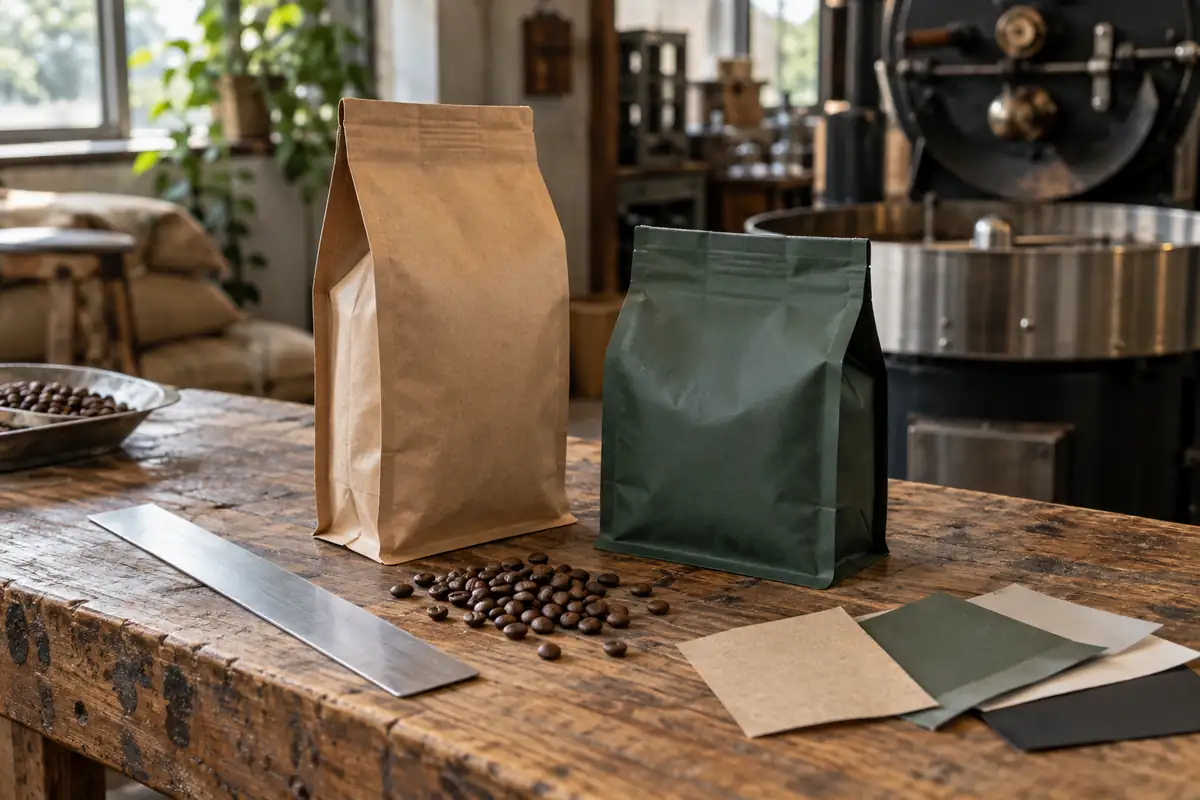
A 250g bag of whole-bean coffee needs about 0.6–0.8 L of product volume, a 500g bag about 1.2–1.6 L, and a 1kg bag about 2.4–3.2 L. In a flat bottom pouch, that works out to roughly 120–140 × 200–230 × 70–90 mm for 250g, 130–160 × 250–290 × 80–100 mm for 500g, and 150–190 × 300–360 × 90–120 mm for 1kg.
Stand-up and side gusset bags hold the same coffee in different dimensions, so the chart below covers flat bottom pouches only. The other two styles have their own size guides, linked further down.
Flat bottom pouch sizes by coffee weight
| Coffee weight | Approx. product volume | Pouch size (W × H × D) |
|---|
| 250g (8.8 oz) | 0.6–0.8 L | 120–140 × 200–230 × 70–90 mm |
| 500g (17.6 oz) | 1.2–1.6 L | 130–160 × 250–290 × 80–100 mm |
| 1kg (35.3 oz) | 2.4–3.2 L | 150–190 × 300–360 × 90–120 mm |
Source: Illusion Pack flat bottom pouch size ranges, for whole roasted coffee beans.
These ranges are starting points, not universal standards. Bean origin, roast degree, zipper position, seal width and how the pouch is built can all move the result by a few millimetres either way.
Does the bag style change the size?
Yes. Volume depends on shape as well as width and height. A flat bottom pouch has a square base and straight sides, so it uses its space efficiently. A stand-up pouch has a rounded bottom gusset and usually holds a little less than a flat bottom pouch of the same face size. A side gusset bag expands along its folds and fills out differently again.
So a size that works for one style should not be copied to another. For measurements by style, see our guides to flat bottom pouches, stand-up pouches and side gusset bags. If you are still choosing a format, coffee bag types explained compares the three.
What changes how much coffee fits
Roast level matters most. Darker roasts are less dense than lighter ones, so 500g of dark roast takes up more room than 500g of light roast and may need the larger end of the range.
Grind matters too. Ground coffee packs more tightly than whole beans, so a bag for ground coffee can sometimes be smaller. Settling varies with grind size, so check with a real fill.
Then there is the top of the bag. The zipper, the top seal and a degassing valve all use height, which is why two pouches with the same listed size can leave different usable space for the coffee.
How to choose a size
- Take the retail weight from your label, for example 250g.
- Pick the matching row in the chart and note the width, height and depth range.
- Choose the larger end of the range for dark roasts and the smaller end for ground coffee.
- Check where the zipper and valve will sit before you fix the height.
- Fill one sample with your own coffee on your own line before you order a full run.
Step 5 catches most problems. A new size can change sealing time and how the pouch behaves on the filling machine, and none of that shows up on a spec sheet.
Watch the units as well. 8 oz is 227g, not 250g, and 1 lb is 454g, not 500g. A bag sized for 500g will have more room than a 1 lb label needs.
From Coffee Bag Size to a Production Order
Once you have checked the fit with your coffee, confirm the material, valve, closure and artwork on the same drawing. Explore our custom printed coffee bags and follow the roaster’s ordering checklist before approving a wholesale order.